
Sled Training: A Superior Conditioning Method
Introduction
While barbells and dumbbells rightfully command the admiration of strength enthusiasts, sled training stands out as an unparalleled choice for conditioning.
Why Sled Training?
Minimal Learning Curve: Sled training is inclusive, suitable for a wide spectrum of individuals, from elite college athletes to Medicare beneficiaries.
Low Stress on Joints and Nervous System: The reduced stress on joints and the nervous system allows for rapid recovery even after intense sessions.
Time - Efficient and Effective: In just a few minutes, sled training can elevate heart rate significantly and induce intense leg pumps, making it a highly efficient training tool.
The Conundrum of "How - To"
Despite the clear benefits of sled training, many lifters remain uncertain about the practical aspects:
Frequency: How often should sled exercises be incorporated?
Repetitions: What is the optimal number of reps?
Distance: How far should one push or pull the sled?
Rest Intervals: How much rest is required between sets?
Typically, most athletes add sled exercises once or twice a week, usually at the end of a workout. The distance is often determined based on daily preference, with the exercise continuing until the intense burn in the quadriceps becomes overpowering or until physical discomfort dictates a stop.
However, when the objective is to rapidly enhance work capacity, a more structured approach prevails over random pushing or pulling of the sled. A high - frequency approach based on a heavy/light system has proven effective. This method is employed with hockey players during the early off - season to strengthen their legs and lungs while providing a respite for joints after a strenuous hockey season. For dedicated athletes and lifters, it's an efficient way to enhance overall fitness and burn calories without sacrificing strength, as can occur with high - volume traditional cardio. All it takes is a couple of exercises and six weeks to witness substantial improvements in work capacity.
The Exercises
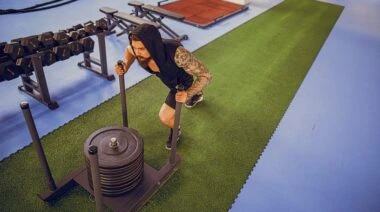
Sled Push
Despite its simplicity, some individuals misexecute the sled push, leading to poor form and wasted effort. Adhere to these technique guidelines:
Grasp the uprights near the top.
Lean forward at approximately 45 degrees, similar to accelerating in the initial five yards of a 40 - yard sprint.
Engage the core and maintain a neutral spine.
Keep the hips level; avoid excessive hip movement.
Push down and back with the ball of the foot, keeping the heel off the ground.
Complete each step by extending the hip.
Sled Drag
In the absence of uprights on the sled, attach a chin - up belt around the waist and drag the sled.
The same technique cues as the sled push apply: lean forward, maintain a tight body, and extend with each stride. As the arms are free, move them in synchronization with the legs.
Backward Sled Walk
Fasten a chin - up belt around the waist.
With slightly bent hips, lean back to initiate movement of the sled.
Step back, leading with the ball of the foot and pushing the heel into the ground.
Finish each step by extending the knee. Although this variation may not appear difficult, it can cause intense quadriceps fatigue when performed with sufficient weight or distance.
The Program
This six - week program is divided into two three - week phases, following a long - to - short progression.
Phase 1: Commence with lighter loads, longer distances, and incomplete recovery.
Phase 2: Increase the weight, shorten the distance, and extend the rest periods.
Workout Frequency: Both phases consist of four workouts per week. Two workouts involve forward pushing or dragging of the sled, while the other two entail walking backward with the sled.
Phase 1
Day 1
| Week | Reps | Rest |
|------|------|------|
| 1 | 6 | 90 Seconds |
| 2 | 6 | 90 Seconds |
| 3 | 6 | 90 Seconds |
Day 2
| Week | Reps | Rest |
|------|------|------|
| 1 | 6 | 60 Seconds |
| 2 | 7 | 60 Seconds |
| 3 | 8 | 60 Seconds |
Day 3
| Week | Reps | Rest |
|------|------|------|
| 1 | 6 | 90 Seconds |
| 2 | 6 | 90 Seconds |
| 3 | 6 | 90 Seconds |
Day 4
| Week | Reps | Rest |
|------|------|------|
| 1 | 6 | 60 Seconds |
| 2 | 7 | 60 Seconds |
| 3 | 8 | 60 Seconds |
Note #1: For those using the Imperial system, yards can be substituted for meters for convenience. For precise conversions, multiply the given distance by 1.1 (e.g., 30 meters is equivalent to 33 yards).
Note #2: In cases where gym space is limited, such as having only a 20 - meter turf area, complete the required distance by traversing the length multiple times. Even with a 10 - or 15 - meter turf space, training can still be effective. Do not use limited space as an excuse.
Phase 1 Instructions
Perform each sled drill either at the conclusion of your strength workout or in a separate session.
The resistance used depends on the sled's weight and the friction of the surface. Since resistance cannot be standardized across all situations and athletes, unlike in barbell squats or deadlifts, specific loading parameters are impractical. Instead, start with the following guidelines:
The aim is to increase heart rate without reaching the lactic threshold, similar to brisk walking with a weight vest.
Maintain a steady rhythm and cover the required distance.
Expect to sweat and become slightly out of breath, but not to the extent that completing the workout is difficult.
Use the same weight throughout the workout, which is likely lighter than anticipated. Athletes typically begin with a single 45 - or 55 - pound plate on the sled. For example, in the first week:
| Rep | Weight |
|------|------|
| 1 | 45 lb |
| 2 | 45 lb |
| 3 | 45 lb |
| 4 | 45 lb |
| 5 | 45 lb |
| 6 | 45 lb |
The goal is to strengthen the heart and lungs at lower intensities, facilitating faster recovery in Phase 2 when the training becomes more challenging. Overload is achieved by adding one rep per week, starting at six and reaching eight over a three - week cycle.
30 - Meter Sled Push/Drag & Backward Sled Walk (Heavy Day)
- Simplify the process by adding weight and giving maximum effort. Work up to a top set for the day. If additional sets remain after reaching the maximum, reduce the load to a lighter but still challenging weight. For example:
| Rep | Weight |
|------|------|
| 1 | 225 lb |
| 2 | 235 lb |
| 3 | 245 lb |
| 4 | 250 lb (max for the day) |
| 5 | 240 lb |
| 6 | 235 lb |
Repetitions remain at six throughout the cycle, with overload achieved by increasing resistance in each session. In the subsequent week, aim to surpass the previous week's maximum weight.
Phase 2
Day 1
| Week | Reps | Rest |
|------|------|------|
| 1 | 6 | 120 Seconds |
| 2 | 6 | 120 Seconds |
| 3 | 6 | 120 Seconds |
Day 2
| Week | Reps | Rest |
|------|------|------|
| 1 | 6 | 75 Seconds |
| 2 | 7 | 75 Seconds |
| 3 | 8 | 75 Seconds |
Day 3
| Week | Reps | Rest |
|------|------|------|
| 1 | 6 | 120 Seconds |
| 2 | 6 | 120 Seconds |
| 3 | 6 | 120 Seconds |
Day 4
| Week | Reps | Rest |
|------|------|------|
| 1 | 6 | 75 Seconds |
| 2 | 7 | 75 Seconds |
| 3 | 8 | 75 Seconds |
Phase 2 Instructions
- The effort level in Phase 2 is between that of Phase 1, more intense than the 60 - meter drills but less exhausting than the 30 - meter ones. Select a fixed resistance accordingly. For example:
| Rep | Weight |
|------|------|
| 1 | 90 lb |
| 2 | 90 lb |
| 3 | 90 lb |
| 4 | 90 lb |
| 5 | 90 lb |
| 6 | 90 lb |
The objective is not to overexert but to perform sub - maximal work to build a foundation. When, after the last rep, you are gasping for air but feel capable of doing 1 - 2 more reps without complete exhaustion, you are on the right track. Similar to Phase 1, add one rep per week, starting at six and ending at eight.
- For the 15 - meter sled exercises, load the sled to its maximum capacity. This short distance is sufficient to push you to your limits, with the intense muscle burn and discomfort setting in by the third rep. Push through the pain, ignore the discomfort, and finish strong. Work up to a top set and, if additional sets are required, reduce the weight on the sled. For example:
| Rep | Weight |
|------|------|
| 1 | 315 lb |
| 2 | 335 lb |
| 3 | 350 lb |
| 4 | 360 lb |
| 5 | 370 lb (max for the day) |
| 6 | 350 lb |
In the following weeks, aim to exceed the previous week's maximum weight.
Conclusion
Do not be deceived by the program's simplicity. Although the workouts may not seem overly intense on paper, they are highly effective. In six weeks, expect a notable increase in work capacity and significant unilateral leg strength.
Progression
After completing the six - week program, you can repeat it multiple times with heavier loads. For instance, the 45 - pound plate used in the first 60 - meter cycle can be increased to 55 - 65 pounds in the second cycle and up to 75 - 85 pounds in the third. Continuously strive to add more weight in each subsequent cycle, and you will soon achieve sled - related personal records that currently seem unattainable.
A Six-Week Sled Training Program
•
Author: Steve Keane
•
Fitness
Health
Share this article